Back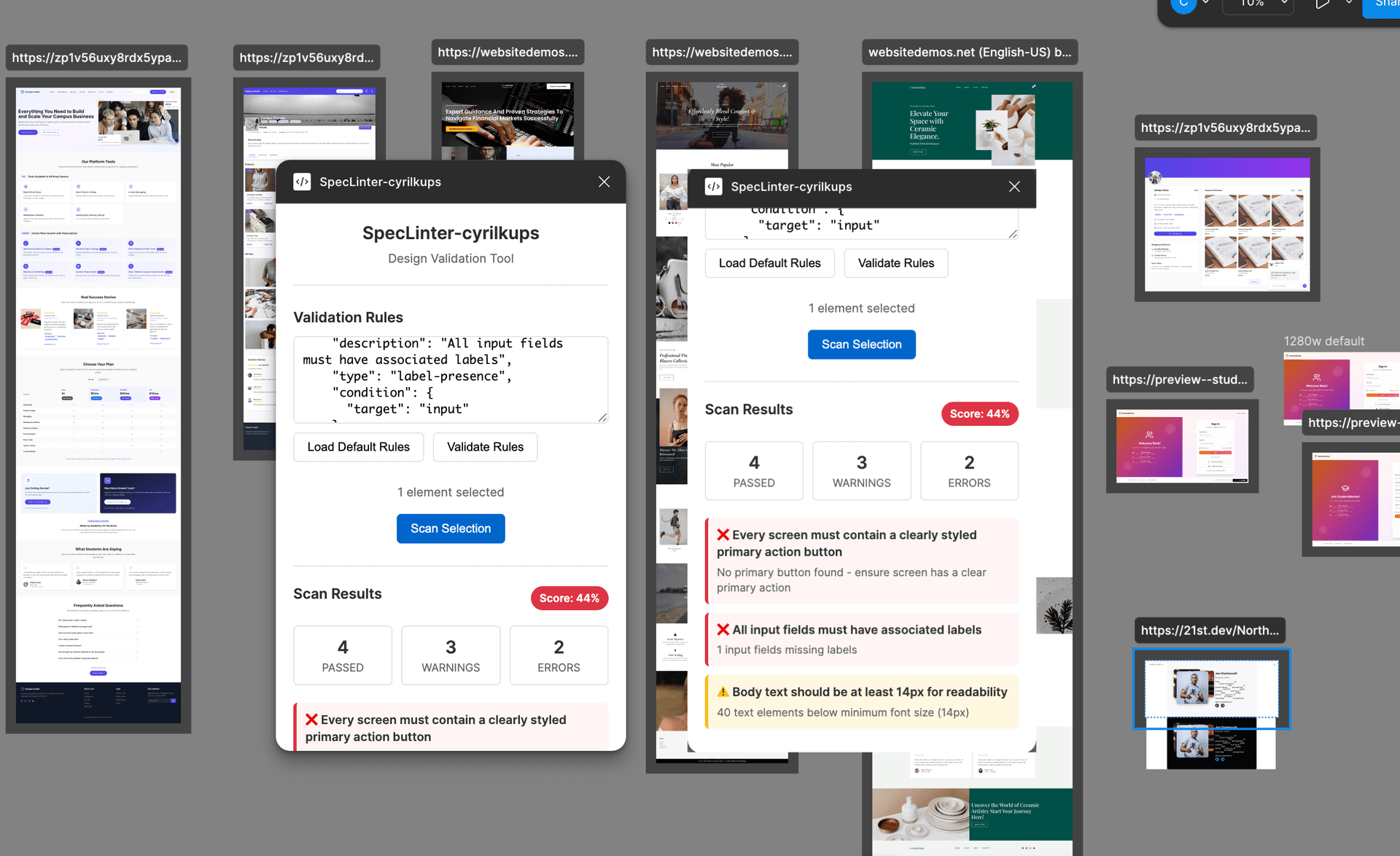
Year
2025
Tech & Technique
TypeScript, Node.js, JSON Rule Engine, AST Parsing, File I/O Processing, CLI Tooling, Modular Plugin Architecture
Description
SpecLinter is a backend specification validation engine that analyzes product requirement documents and component specifications to detect inconsistencies, missing assumptions, and spec–implementation mismatches. The tool enables consistent, repeatable validation of specs before engineers begin building, reducing ambiguity, misalignment, and rework across teams.
Key Features:
Technical Highlights:
Key Features:
- 🧠 Rule-Based Specification Checking: Validates requirements using configurable rule sets (e.g., naming, constraints, parameter expectations)
- 📄 Structured Document Parsing: Reads YAML, JSON, or Markdown-based specs and converts them into a normalized internal representation
- 🧩 Modular Rule Engine: Teams can define custom rule modules that can be swapped, extended, or tuned per project
- 🏗️ Schema Compliance Enforcement: Checks field types, required fields, param ranges, and API signature consistency
- ⚙️ Batch + CI Mode: Runs as a command-line tool or as part of automated CI pipelines to prevent invalid specs from shipping
Technical Highlights:
- Custom Parser & AST Builder: Converts semi-structured spec documents into an abstract syntax tree, enabling rule-based analysis
- Rule Engine Runtime: Designed a multi-pass evaluation pipeline that performs validation at field level, schema level, and cross-component dependency level
- Human-Readable Output Reports: Produces categorized issue summaries with severity levels and suggested corrections
- CI Integration: Can be added to GitHub Actions or GitLab CI to fail builds when specs violate required policy
- Zero UI Dependency: Entire system runs in Node.js — no user interface required
My Role
Systems Architect • Backend Engineer
Problem Definition:
Problem Definition:
- Identified recurring ambiguity in product specification workflows
- Designed modular rule engine to allow project-specific validation logic
- Built AST transformer + validation pipeline in TypeScript
- Created JSON-based rule definition system for team customization
- Integrated into CI to prevent spec merges that fail checks
Case Study Impact
Problem: Specs often contain inconsistencies that only surface during implementation — causing delays, backtracking, and disagreements across teams.
Solution: A backend-only linting engine that validates specifications before implementation starts — ensuring shared understanding and reducing risk.
Outcome:
Solution: A backend-only linting engine that validates specifications before implementation starts — ensuring shared understanding and reducing risk.
Outcome:
- ✅ Reduced spec-change churn and early-phase misunderstandings
- ✅ Enabled standardized spec reviews across multiple contributors
- ✅ Created a workflow that scales to teams, not individuals
Follow GitHub repo instructions to install plugin